
Longtime Apple Enthusiast: Pure eSIM Isn’t Quite as Practical
Xiao Tian was among the earliest adopters of eSIM in mainland China—and also a longtime Apple fan. In 2017, Apple launched the cellular-enabled Apple Watch Series 3; the following year, China Unicom piloted its “One Number, Two Devices” eSIM service for the Apple Watch Series 3 in select cities. Xiao Tian promptly purchased the smartwatch and activated the service—going so far as to obtain a dedicated China Unicom SIM card specifically for it.
When the mainland China version of the iPhone Air launched in 2025, Xiao Tian bought it immediately. However, his motivation wasn’t eSIM—he was primarily drawn to the device’s ultra-slim, lightweight design. Since it’s a pure eSIM phone, he had no choice but to activate an eSIM plan.
Xiao Tian believes eSIM in mainland China still faces numerous restrictions. The most cumbersome hurdle is the requirement to visit a physical carrier store. When eSIM first launched in mainland China, carrier staff training was insufficient: only a handful of stores could process eSIM activations, and many frontline employees were unfamiliar with the procedures, resulting in inconsistent, error-prone service delivery.
Another limitation is that mainland China eSIM devices support a maximum of two eSIM profiles—a constraint Xiao Tian finds particularly frustrating. “When traveling abroad,” he explains, “I usually purchase a local data-only SIM. Theoretically, eSIM should be far more convenient: I’d simply buy an eSIM data package via a travel platform and install it directly onto my phone. In practice, however, that’s not feasible—because my phone already holds two eSIM profiles, there’s no room left for the overseas data plan. To install it, I must first delete one of my existing eSIMs, then later return to a physical store to restore it upon returning home.”
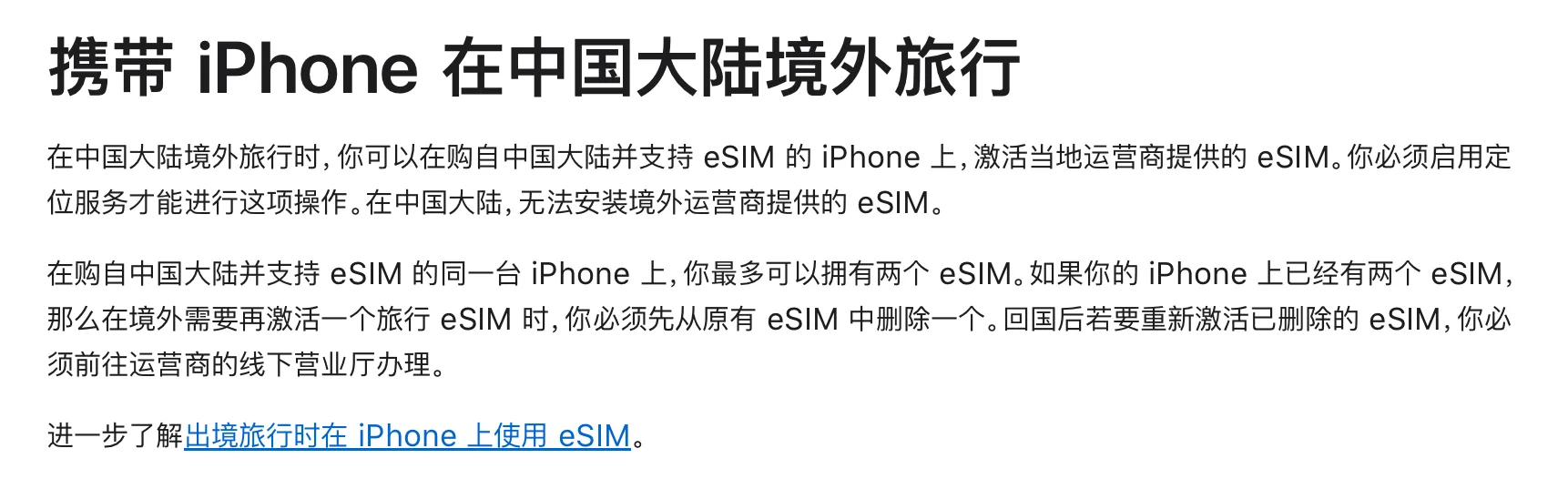
(Image source: Apple)
This situation ironically makes eSIM *less* convenient than physical SIM cards—after all, inserting or swapping a physical SIM is instantaneous and requires no administrative overhead. For Xiao Tian, therefore, a pure eSIM smartphone isn’t especially practical: the operational hassles it introduces outweigh its convenience benefits for daily use.
Dual-SIM User: eSIM + Physical SIM Tray Is the Optimal Solution
Jia Jia also owns an iPhone Air—but she doesn’t use it as her primary device. Given its compromised camera system and subpar speaker output, she relies instead on an Android phone with two physical SIM slots, using the iPhone Air solely with a single eSIM profile.
For her, the main advantage of the iPhone Air’s eSIM functionality lies in activating overseas data plans while traveling. Because she keeps one eSIM slot free, purchasing and installing international eSIM data packages is straightforward. Although mainland China eSIM phones currently cannot activate or install overseas eSIM profiles within mainland China, users can pre-purchase and download activation QR codes online—then scan and install them immediately upon landing abroad.
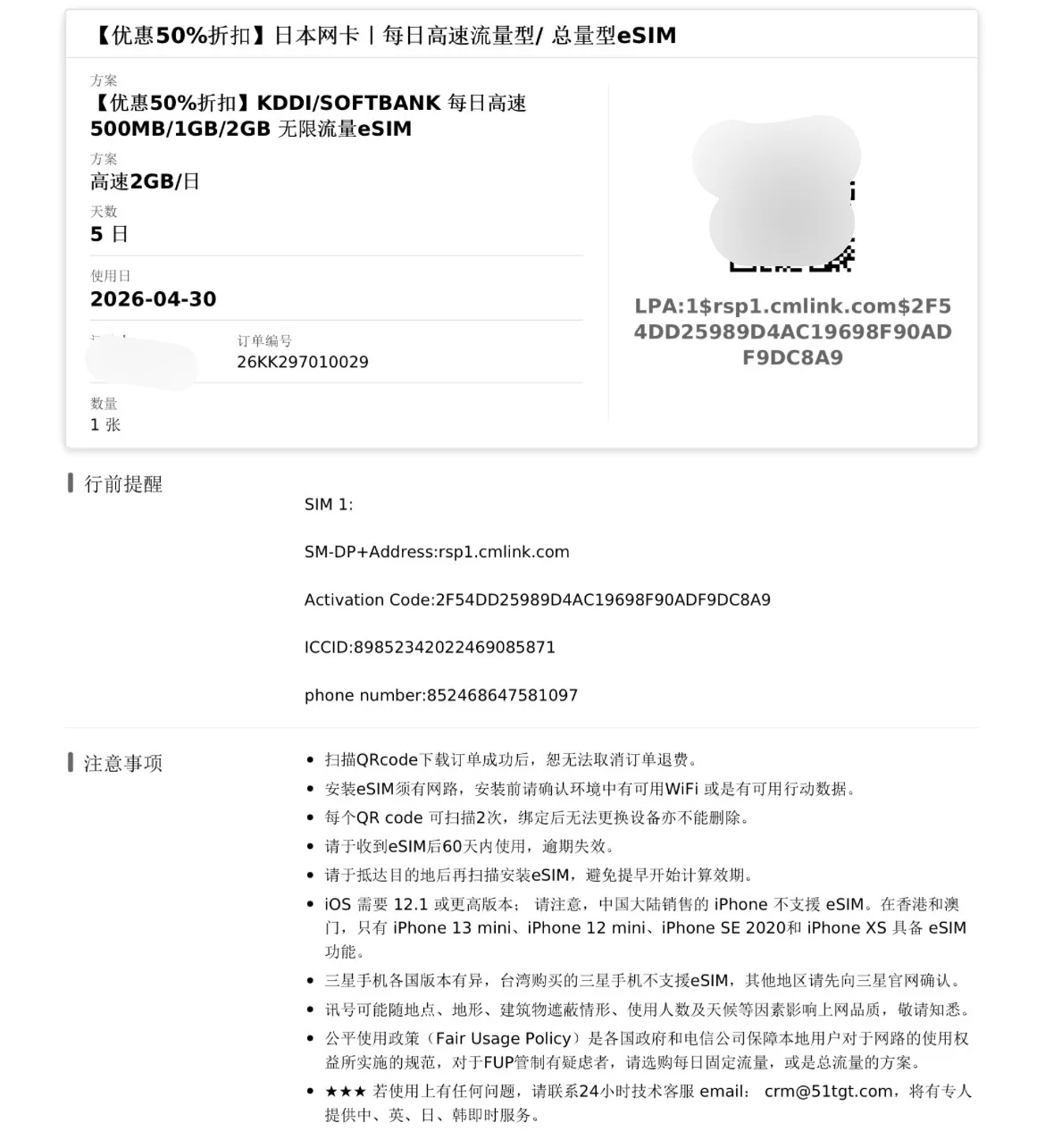
(Image source: Agoda)
This year, Jia Jia also purchased an iPhone 18 Pro and needed to migrate her number from the iPhone Air. Initially, she planned to visit a carrier store to request a replacement physical SIM card for insertion into her new device. But she soon discovered that—even though the mainland China version of the iPhone 18 Pro uses a dual-physical-SIM configuration—it also supports eSIM. She thus simply visited a carrier store to transfer her existing eSIM profile directly to the new phone.
Today, her iPhone 18 Pro hosts one eSIM profile alongside a physical SIM card. Moreover, since the iPhone 18 Pro supports dual eSIM, she maintains one physical SIM for daily domestic use while reserving the second eSIM slot for international travel—deactivating the physical SIM and switching to an overseas data eSIM when abroad.
Jia Jia concludes that, given current regulatory policies and real-world conditions in mainland China, the eSIM + physical SIM tray combination remains the optimal approach—offering greater convenience and flexibility.
Android User: Stick with Physical SIM Cards
Apple has been the most proactive brand in promoting mobile eSIM adoption—but Android OEMs are also taking action. Although eSIM rollout on Android devices lags behind iPhones, progress has been made: Samsung, Huawei, OPPO, Honor, and Lenovo have all released mainland China smartphones supporting eSIM.
Yet veteran Android user Xiao Jie still prefers physical SIM cards. This year, he purchased a mainland China version of the Samsung Galaxy S26, which supports eSIM. Eager to try it out, he visited a physical carrier store to activate an eSIM profile. Staff there informed him that eSIM activation wasn’t supported for Android devices. Xiao Jie then contacted online customer service; days later, a carrier supervisor designated a specific store and trained personnel to handle his request.
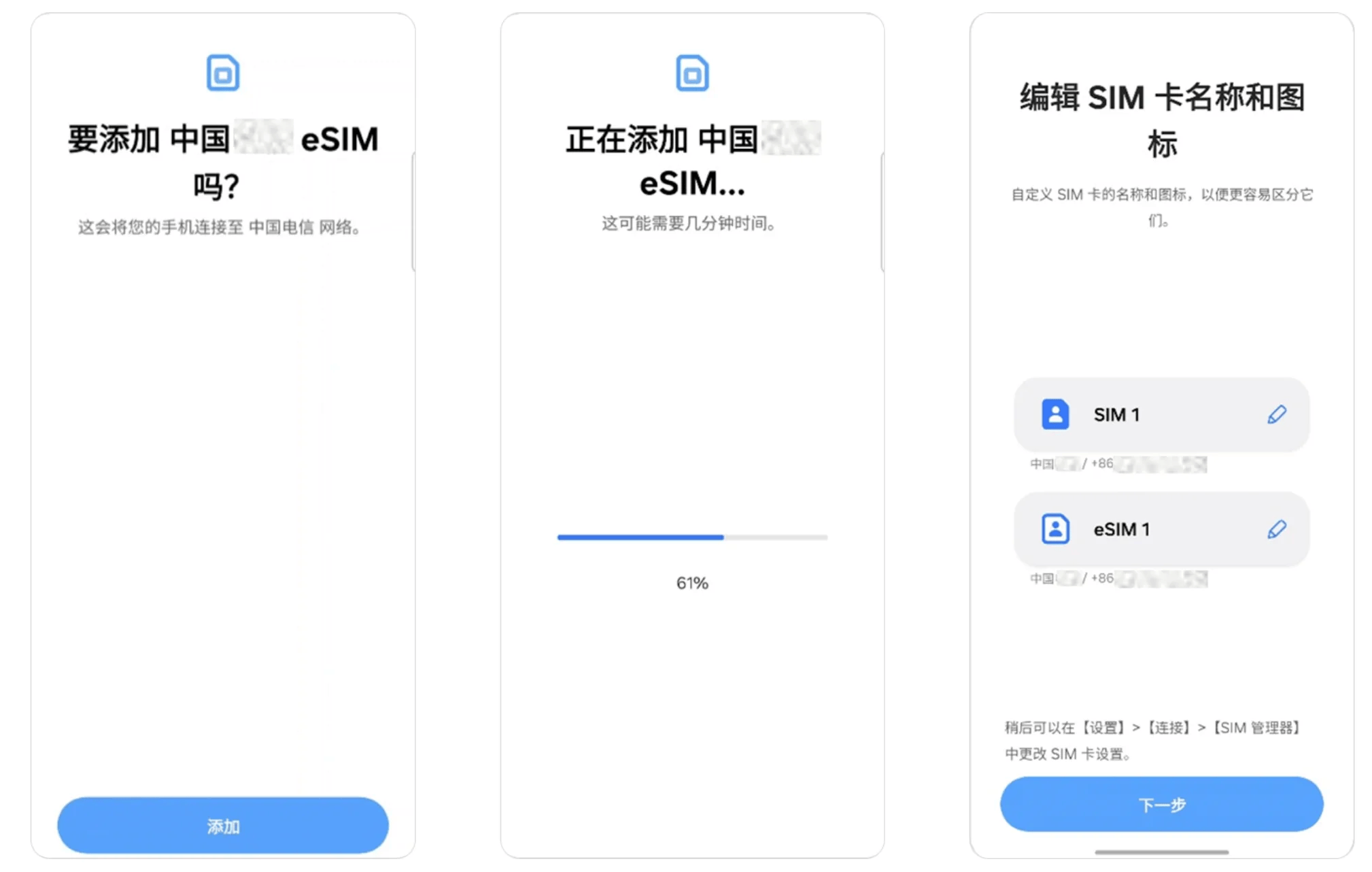
(Image source: Samsung)
Xiao Jie’s experience reveals a clear gap: carrier staff training for eSIM services is currently focused almost exclusively on iPhones, leaving many frontline employees unfamiliar with Android eSIM activation procedures.
He believes that even if an Android device supports eSIM, it will invariably retain a physical SIM tray—and under current conditions, relying on physical SIM cards remains the most hassle-free option. Using eSIM for novelty purposes is fine, but activating your primary number via eSIM still requires visiting a physical store for nearly every related procedure—making it inconvenient overall.
One Year After Launch: Mainland China eSIM Adoption Accelerates
Based on these users’ firsthand experiences, the optimal eSIM implementation for mainland China smartphones today remains the hybrid physical-SIM-tray-plus-eSIM configuration. Under current regulatory frameworks, numerous eSIM-related operations—including activation, replacement, porting, and cancellation—cannot yet be performed online and still require visits to physical carrier stores. Consequently, eSIM’s core convenience advantages are significantly diminished—and in certain scenarios, it proves less practical than physical SIM cards.
Thus, eSIM today functions best as an *additional* smartphone feature—not as a direct replacement for physical SIM trays. A pure eSIM approach like that of the iPhone Air risks delivering a subpar user experience, which could negatively impact device sales.
All three major carriers now support eSIM activation—but China Unicom has demonstrated the highest level of enthusiasm. At present, iPad cellular models’ eSIM functionality is supported exclusively by China Unicom. Additionally, China Unicom has repeatedly stated its commitment to accelerating eSIM adoption across smartphones.
In September this year, China Unicom launched its “eSIM Trial Season 2026” upgrade initiative, announcing promotional incentives—including perks and rewards—to encourage users to activate eSIM. The carrier also reported that domestic eSIM smartphone sales reached one million units in the first half of 2026, with projections exceeding 20 million units in the second half.
Currently, Apple offers five mainland China eSIM-compatible iPhone models: the iPhone Air, iPhone 17e, iPhone 18 Pro, iPhone 18 Pro Max, and iPhone Duo. Apple’s SIM configurations fall into three categories: pure eSIM, single physical SIM tray + eSIM, and dual physical SIM trays + eSIM. Aside from uniquely configured models like the iPhone Air and iPhone Duo, most other iPhones continue to adopt the physical-SIM-tray-plus-eSIM hybrid approach.
Beyond Apple, Huawei has aggressively pushed eSIM adoption. Nearly all of Huawei’s flagship smartphones launched this year—including the Mate 90 series, Pura X Max, Pura X View, and Mate XT 2 Ultimate Edition—support eSIM. Huawei implements a dual-physical-SIM-tray-plus-dual-eSIM configuration. Similarly, most Samsung flagship models—including the Galaxy S26 series and Galaxy Z Fold8—also support eSIM.
(Image source: Huawei)
In contrast, other Android brands have taken a more cautious, exploratory stance toward mainland China eSIM—releasing only one or two compatible models as test cases. Examples include OPPO’s Find X9 Pro Satellite Edition (launched last year) and Honor’s Magic8 Pro Air (launched this year).
Frankly speaking, the Android ecosystem’s relatively low enthusiasm for eSIM stems fundamentally from poor cost-benefit ratios. In our view, the ultimate goal of pure eSIM is to eliminate physical SIM trays entirely—freeing up internal space while enhancing user experience. Yet user feedback above suggests that adopting such an aggressive, physical-SIM-tray-eliminating approach—as seen with the iPhone Air—may actually degrade usability on Android devices.
This reality forces most manufacturers to retain dual physical SIM trays while adding eSIM support—inevitably increasing hardware costs. For average consumers, however, the functional value of eSIM remains largely imperceptible. Put plainly, aside from Huawei and Samsung—which rely on full-featured flagships to maintain premium positioning and pack in every cutting-edge capability—most domestic brands currently introduce one or two eSIM models primarily as a defensive strategy: “You may not need it—but I can’t afford not to offer it.”
Given that most terminal manufacturers already possess the necessary technical expertise, when will the true pure eSIM era finally arrive?
In fact, the core bottleneck hindering widespread eSIM adoption lies in the tension between carrier service systems and existing regulatory mechanisms. eSIM’s original vision was to let users switch carriers as effortlessly as connecting to Wi-Fi—but under current real-name registration and cybersecurity requirements, seamless online activation and number portability remain unrealized.
Unless unexpected developments occur, the physical-SIM-tray-plus-eSIM configuration will likely dominate the vast majority of mainland China smartphones for the foreseeable future: physical SIMs will continue handling stable, hassle-free daily communications, while eSIM serves as a supplementary tool for international roaming and temporary data packages—functioning essentially as an upgraded version of services like “SkyLink” or “WuXinHang.”